
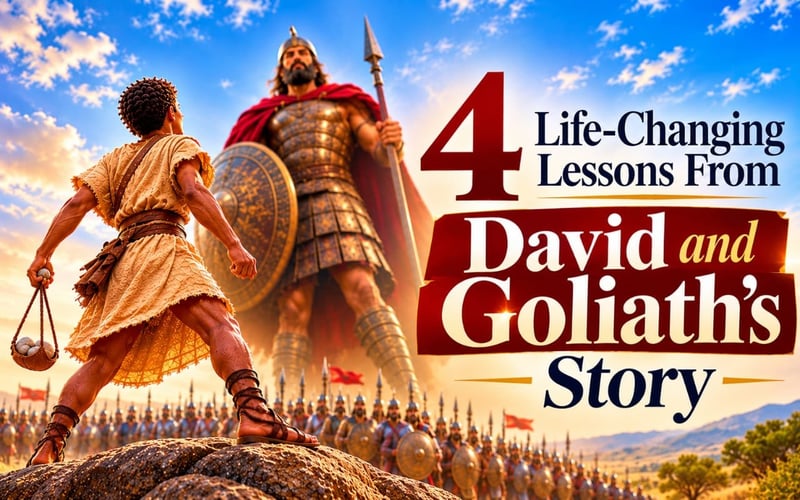
Many of us know the story of David and Goliath, an all time favourite of bible stories in children's class during Sunday school, we even formed songs around the victory. A young shepherd boy goes up against a giant warrior, armed with nothing but a sling and a few stones, and comes out victorious. It's one of those Bible stories we have heard so many times, but what if there's a part of that story we never really took time to look at. There is still a lot to learn from it, especially when we pay attention to what happened before David faced Goliath.
Think about it. Before David ever picked up a stone, he had to deal with his brother's accusations, Saul's doubts and the fear that had kept an entire army from confronting Goliath. There was a lot happening before the famous victory. From the way he responded to opposition to the confidence he had in God's ability to help him, David's story teaches us lessons that go beyond facing our own giants.
Here are four lessons we can learn from 1 Samuel 17.
1. Don't Let Your Present Situation Make You Forget Who God Is
1 Samuel 17:26
By the time David arrived at the battlefield, Goliath had been challenging the army of Israel for forty days. The soldiers were afraid, and no one seemed willing to face him. But David had a different reaction. Rather than seeing Goliath as an unbeatable warrior, he saw someone who was defying the army of the living God.
David looked at the situation from an entirely different perspective. The soldiers were focused on how big and powerful Goliath was, but David was more concerned about what his actions meant in the presence of God. Notice that David did not pretend Goliath was harmless, he knew the man was a threat. However, he refused to look at the situation without considering who God was.
Sometimes, we can become so focused on what is happening around us that we forget who God is. A difficult situation can begin to look bigger than everything we know about Him. We become so occupied with the problem that we struggle to remember His promises and faithfulness. Perhaps you've been praying about a particular situation for a long time. Maybe it's a health challenge, a financial difficulty or a season in which nothing seems to be going as expected. It's easy to become discouraged when the situation doesn't change as quickly as you hoped.
David's response reminds us not to allow what we see to become the only thing we consider when faced with a difficult situation, don't let it become the reason you doubt God's ability to help you, instead let your knowledge of who God is be your strength and the only thing that should matter.
2. Not Everyone Will Understand What God Has Placed In Your Heart
1 Samuel 17:28-30
When David began asking questions about Goliath, his older brother Eliab became angry with him. He accused David of being proud and questioned why he had left the sheep to come to the battlefield. Interestingly, Eliab did not even try to understand why David was asking those questions. He simply assumed the worst about him. David could have spent the rest of the conversation defending himself, or trying to explain himself but he didn't. He responded briefly and moved on to speak with someone else.
Imagine David had allowed that conversation to consume his attention. He could have spent so much time trying to prove himself right that he lost sight of why he was asking the question in the first place.
There will be times when people misunderstand your intentions. Some may question why you are doing what you are doing, while others may make assumptions without knowing the full story. It can be frustrating, especially when the misunderstanding comes from people close to you. You may feel the need to explain every decision and make everyone understand your intentions. But you cannot spend all your time trying to explain yourself to everyone. There are conversations that need your response, and there are others you need to move past.
This doesn't mean you should never listen when someone corrects or questions you. Sometimes, people point out things we genuinely need to consider. But you must learn to recognise when a conversation is no longer helpful. David understood this, so, he did not allow his brother's words to distract him from what was happening on the battlefield and what he felt led to do.
3. Check Your Portfolio, there Are God's Doings There!
1 Samuel 17:34-37
This is one of the most interesting parts of the story. When Saul questioned David's ability to fight Goliath, David did not just insist that he could do it. He gave an account of what God had already helped him do. He spoke about the lion and the bear that had attacked his father's sheep. On both occasions, David had gone after them and rescued the sheep. He then said that the same God who delivered him from the lion and the bear would deliver him from Goliath.
Think about that for a moment. David remembered what God had done for him, and those experiences strengthened his confidence as he prepared to face Goliath. Those were his memorials, his weapons and his armour, testimonies of when God had come through for him in the past.
Sometimes, when a new challenge comes, we become so worried about what might happen that we forget to look back at the times God helped us in the past. There are prayers He answered, situations He brought you through and moments when you didn't even know how things would work out, but somehow, they did.
Remembering these things does not mean every situation will end in exactly the same way. It reminds us that we have reasons to trust God, even when we do not know how things will turn out. Think about someone who once trusted God for ₦5,000 and received help through an unexpected favour. Now, that same person is faced with an opportunity worth millions and begins to wonder whether God can come through again.
The amount may be different, and the situation may be bigger, but has God changed?
This is not about assuming that every request will be answered in the exact way we expect. It's about remembering that the God who has been faithful in the past has not suddenly become incapable of helping us today. So, before you become overwhelmed by what is in front of you, take a moment to look back. Remember the prayers, the help, the open doors and the difficult seasons God brought you through.
Check your portfolio. There are God's doings there!
4. You Don't Have to Fight in Someone Else's Armour
1 Samuel 17:38–40
Before David went out to face Goliath, Saul gave him his armour. David tried it on, but he was not comfortable with it because he was not used to wearing it. He eventually took it off and chose five smooth stones from the brook instead. It is so easy to wonder why David would reject the armour of a king when he was about to face a trained warrior. But David knew he could not fight effectively with something he had not learnt to use.
There is a lesson in this for us. Sometimes, we become so focused on what others can do that we overlook the abilities God has given us. We see someone else's talent, approach or area of strength and begin to think we must be like them to achieve similar results. In the process, we neglect the very things we could have developed and used effectively.
What abilities has God placed in your hands? What are you naturally good at? What skills have you developed that could be put to good use? Rather than constantly wishing you had what someone else possesses, recognise what you have and make the most of it.
David did not need to become like Saul to face Goliath. He used what he was familiar with and what he knew how to handle. His confidence was not in the sling or the stones. He had already made it clear that his confidence was in God. The equipment was simply what he was familiar with. His ability with the sling was useful as that was the tool God worked with but he knew that God was the one who would give him victory.
Don't spend so much time wishing you had someone else's equipment that you neglect what God has placed in your own hands. Recognise it, develop it and put it to good use.
Conclusion
There is more to the story of David and Goliath than the moment a stone struck a giant. Before that victory, David had to deal with accusations, face the doubts of others, remember God's faithfulness and make a choice about the equipment he would use.
Each part of the story gives us something to think about. We can learn to not let difficult situations make us forget who God is, not to allow people's opinions to distract us, not to overlook what God has already done. We can also learn to recognise the abilities He has placed in our hands and make good use of them.
Above all, David's story reminds us that our confidence must always remain in God. The size of the challenge, the opinions of others and even the resources available to us should not make us lose sight of the One who is able to help us.
So, the next time you find yourself facing a situation that seems bigger than you, remember David. Remember what God has done, be mindful of what He has placed in your hands, and above all, remember who He is.
You may have heard this story many times, but there is still something to learn from it. Perhaps it's time to read 1 Samuel 17 again, this time paying attention to everything that happened before the stone was thrown.
Want to understand these lessons more deeply? Don't stop here. Take some time to listen to the message linked to this article and learn more about the principles behind David's victory.