
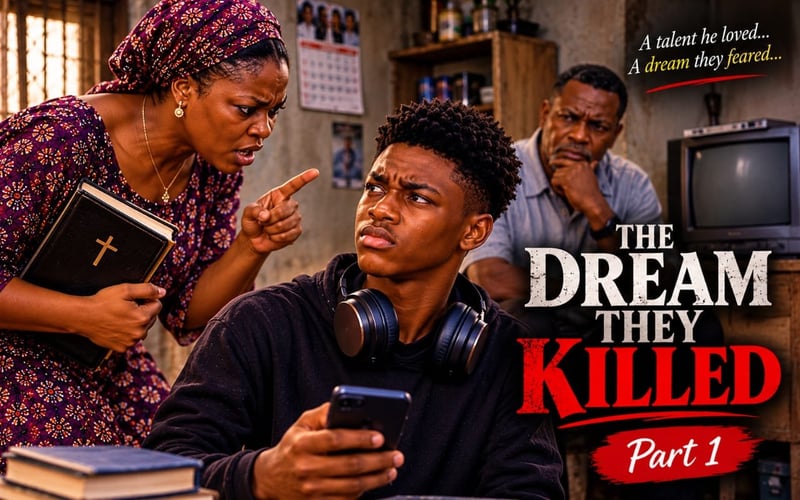
PART 1: THE DREAM THEY WOULDN'T LET HIM CHASE
“Tunde, I said you cannot learn it, and that is final!”
Tunde mum's voice thundered through the Davies' modest sitting room, startling even the neighbours who were used to hearing arguments from the house.
Tunde stood beside the old television, his phone still in his hand. He had been trying to explain himself for almost twenty minutes, but his mother's mind was already made up.
“Mummy, please, just listen to me. It is a free training programme. They are teaching music production, sound mixing, beat-making and even singing. I don't have to pay anything. I only need your permission.”
“Permission for what?” she interrupted. “To go and learn how to sing worldly songs? Is that what you want to use your life for?”
“It's not just singing, Mummy. There is production. There is sound engineering. There are different things I can learn.”
“Different things indeed! After sixteen years of bringing you to church, this is what you have chosen? Have you forgotten that you are the light of the world?”
Tunde looked down at his phone.
He had expected questions. He had expected his mother to ask where the training would take place, who the organisers were, how long it would last or what exactly he hoped to gain from it.
He had not expected to defend his interest as though he had committed a terrible offence.
“Mummy, I am not saying I want to stop going to church.”
“Then why do you want to involve yourself in these things?”
“Because I like music!”
The words came out louder than he intended.
His mother stared at him.
For a moment, neither of them spoke.
“You like music?” she repeated slowly. “And what kind of music? The ones they play in clubs? The ones that encourage young people to behave anyhow?”
“No, Mummy. You are not even trying to understand what I am saying.”
“What is there to understand? The Bible says in 1 John 2:15, ‘Love not the world, neither the things that are in the world.’ Is music not part of the world you are trying to run after?”
“But Mummy, that verse doesn't mean—”
“Don't explain the Bible to me!”
Tunde closed his mouth.
His mother picked up her Bible from the centre table and opened it.
“Romans 12:2 says we should not be conformed to this world. You want to start following people who sing songs that do not glorify God. Tomorrow, you will be dressing like them, talking like them and behaving like them. Is that how you want to end?”
“I just want to learn a skill.”
“A skill? There are many skills in this world. Why must it be music?”
Tunde had no answer that she was willing to hear.
His father, Mr Davies, had been sitting quietly at the other end of the room, reading a newspaper. He folded it and placed it on his lap.
“Tunde, your mother has spoken. Why are you making this an argument?”
“Daddy, I am only asking you to give me a chance.”
“A chance to do what? We sent you to school to study and become somebody in life. Is this what you want to spend your time doing?”
“I can still go to school and learn music.”
His father shook his head.
“Young people always think they know what is good for them. When we were your age, we listened to our parents.”
Tunde swallowed.
“Daddy, the programme is free. I won't even need you to pay for it.”
Money was always a problem in the Davies household. His father worked as a clerk and earned ₦90,000 monthly. His mother operated a small provision shop in front of their house, but the business was barely enough to support the family.
There were months when Tunde had to postpone buying school materials because his parents needed to settle more pressing bills.
He understood their financial situation. That was why the free training programme meant so much to him.
It was an opportunity he could not afford to lose.
But his father soon found another reason to reject it.
“Even if it is free, who knows the kind of people organising it? We cannot allow you to follow every opportunity you see on the internet.”
Tunde's interest in music was not something his friends had forced on him.
He had always been fascinated by sounds. He could spend hours listening to a song and identifying the different instruments. Sometimes, he could recognise a mistake in the arrangement before anyone else noticed it. His friends knew this.
There was Daniel, a Christian boy who attended church with his parents and took his faith seriously. There was Chuka, who was fascinated by sound engineering; Malik, who experimented with beats on his phone; Tobi, who wanted to become a recording artist; and Seyi, who enjoyed writing lyrics and creating melodies.
They had discovered the free training programme together.
For boys who had little money to spend on expensive equipment or professional training, it was an opportunity worth taking.
“You should be the first person to register,” Malik had told Tunde.
“Why?”
“Because you are the one who knows all these things. You always have something to say whenever we play a song.”
The boys had laughed, but Tunde had secretly been pleased.
For the first time, something he had always done for fun seemed capable of becoming something bigger.
Daniel had also told his parents about the opportunity. They made enquiries, asked questions and eventually gave him their approval.
His mother even helped him complete the registration.
“It's good to learn something useful while you are young,” she told him. “You don't know where this knowledge may take you.”
His father agreed.
“Just remember that your education remains important.”
Daniel was grateful.
On Sunday, he mentioned the programme to his pastor. The pastor listened, asked what he hoped to learn and encouraged him to develop his abilities responsibly.
He even prayed for him.
When Tunde heard about it, he was surprised.
“Your pastor prayed for you?”
“Of course.”
“And your parents are okay with it?”
“Why wouldn't they be?”
Tunde laughed faintly.
“I wish my parents could understand it like that.”
A few days later, Daniel's mother called Mummy Tunde. She explained the programme, its benefits and how their children could participate without neglecting their education.
She also mentioned that their pastor had prayed for Daniel.
Mummy Tunde was not impressed.
“Pastor even prayed for him?”
“Yes. He encouraged him and prayed that God would guide him.”
“Well, everybody has their own way of doing things.”
Daniel's mother was confused.
“What do you mean?”
“Madam, how can a pastor encourage a young boy to go into secular music? Is that not a sign of the kind of church he is running?”
Daniel's mother tried to explain that the pastor had not encouraged Daniel to abandon his faith or participate in anything against his values.
But Mummy Tunde had already made up her mind.
After ending the call, she told her husband.
“Can you imagine? Daniel's pastor even prayed for him.”
Mr Davies shook his head.
“That man must be one of those take-away pastors.”
“Exactly. Pastors who want to make everybody happy.”
Neither of them considered that Daniel's pastor might simply have understood the difference between developing a skill and abandoning one's faith.
Things became worse for Tunde.
His parents began questioning his friendships. Whenever Malik or Chuka called, his mother wanted to know who was calling and why. They restricted his movements and stopped allowing him to visit his friends.
He tried explaining that none of them was forcing him to do anything.
It made no difference.
One evening, his father called him into the sitting room.
“We have discussed this matter, and your mother and I have reached a decision.”
Tunde stood before him.
“What decision, Daddy?”
His father looked at him.
Want to know about the decision Tunde's parents came to, read part 2.....