
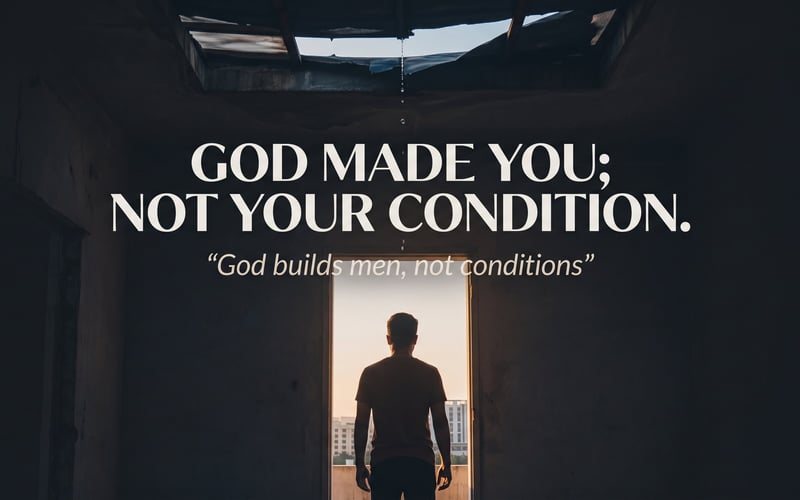
The rain did not knock.
⠀
It came through the roof in the same three places every time, and he knew which one was falling just by the sound. One landed on the stove and hissed against the hot metal, one landed on the bag of garri until it smelled faintly of rust and dust, another landed straight onto his mother's mattress, so on some nights she slept curled against the wall, like something trying to fold itself away from the world.
⠀
Morning had its own language too.
⠀
The smell of kerosene stoves lighting up one after another down the street. A neighbor's radio playing news nobody had money to act on. Children walking to school in uniforms washed so many times the checkered pattern had faded into a memory of itself, in shoes with soles thin enough to feel every stone on the road.
⠀
He would watch them from the window of the room he shared with his mother, chewing a piece of bread that had to last until evening and he would think that hunger had a sound too. A quiet growl that everyone in that compound had agreed never to mention out loud. His mother sold groundnuts by the roadside from a tray balanced on her head. Some evenings she came home having sold almost nothing, and she would sit on the low stool by the doorway and stare at the tray as if it had betrayed her.
⠀
On those nights, dinner was garri soaked in water, with sugar if there was sugar, and without it if there was not. He learned early that hunger does not announce itself with drama. It simply sits with you at the table, quiet and patient, waiting for you to get used to its company. He stopped asking God for a new roof by the time he was eleven, not because he lost faith but because of what a woman at church told him.
⠀
She was wrapped in white cloth so clean it looked like dust was afraid to touch it. One Sunday she held his hands and said this was the portion God had given his family, and that he should learn to carry it with grace. She smelled of good perfume, the kind that clings long after a person has left the room, so he believed her. People whose roofs did not leak always spoke with a certain confidence, and children believe people like that.
⠀
So he carried it.
He carried it through a secondary school where he came third in a class of forty and never once raised his hand to say he wanted to study engineering. In his head, engineers came from houses with generators, and his house did not even have that.
⠀
He carried it through the years his classmates left for university while he stood under the sun at a bus stop, selling sachet water from a wheelbarrow with a wobbling tire. His fingers had learned to count coins long before they learned to hold a pencil properly.
⠀
He carried it into a single room behind a mechanic workshop, where the smell of engine oil sat permanently in his clothes even after washing. At night he could hear rats moving along the ceiling board like they paid rent too, and the only light after dark came from a rechargeable lamp he had to ration like food.
⠀
He built a whole belief system around his suffering.
He called it humility. He called it patience. He called it waiting on God.
⠀
Every Sunday he sat in the third row and thanked God for sustaining him, a word he used so often it had lost its meaning, the way a wound stops hurting once you get used to touching it. He did not know he was doing something dangerous. He was looking at the conditions of his life and calling them the will of God for his life.
Nobody had ever told him there is no greater pain than that. Theologizing your own captivity. Kneeling down to thank God for a cage because someone once told you it was a gift.
⠀
Then something happened that had nothing to do with a sermon or a book.
⠀
His mother fell sick one harmattan season, the kind of sickness that made her cough through the night until her body shook the mattress. He did not have money for a hospital, so he carried her on his back to a clinic three streets away, her arms hanging weak around his neck, her breath uneven against his ear. While the nurse examined her, he sat outside on a bench with his head in his hands. An old man sitting beside him, a stranger whose name he never learned, began speaking without being asked.
⠀
He said he used to be a driver for a wealthy family in the city, and that what struck him most about that house was how differently they spoke about problems. They did not pray over a blocked drainage pipe and wait for it to unblock itself. They called someone. They fixed it. They did not call a leaking roof the will of God. They called a carpenter.
⠀
Then the old man said something that lodged itself deep and would not let go.
⠀
He said God builds men, not conditions. The conditions of a man's life are simply the raw material he has been handed to work with, the way a carpenter is handed rough wood and is not expected to worship the roughness.
Something inside him that had been quietly dying for years opened its eyes, right there on that bench.
⠀
Because if that was true, then the woman in the white cloth had been wrong. Not wicked. Just wrong. His leaking roof was not a portion sent from heaven. His silence in that classroom had never been obedience. It was fear wearing the clothes of religion. His refusal to imagine more for himself had never been faith. It was surrender, dressed carefully to look holy.
⠀
He thought of the mechanics he grew up around, men who never finished school but could diagnose a failing gearbox by ear before touching it. Their environment had been teaching them long before any classroom would have. Nobody had ever told him that counted as knowledge too. That life had already begun preparing him with what surrounded him, long before any certificate could.
⠀
He thought about the plane he used to watch cutting across the sky above that bus stop, small and silver and certain. He used to feel that a wide, unfair gap separated people like him from people like that. He understood now that the gap was real, but a real gap is not the same as a locked door. He thought about all the times he had seen pain in other people and looked away, telling himself he had nothing to give. He understood now that it was not because his heart was hard. He simply had not yet gathered enough strength to carry a weight bigger than his own. A day comes when a man becomes strong enough to carry someone else's pain, and that strength becomes proof of how far he has grown.
⠀
Sitting there on that bench, he understood one more thing, he had spent his whole life waiting for money to be his deliverance. But his first deliverance was never going to be money. It was going to be his eyes. A man given money while his sight remains unchanged will spend it right back into the same old shape of poverty he came from.
⠀
Miracles can hand a man cash. Only new sight can hand him a future.
⠀
He did not live by miracles anymore after that day, he decided to live by principles. When his mother was discharged and they walked home slowly under a sky that had finally cleared, he said nothing about what the old man had told him. But that night, by the light of his rationed lamp, he opened an old notebook with soft corners and wrote down what he was afraid to lose if he waited until morning.
⠀
"I owe it to my destiny to not give up easily. To not blame my past."
⠀
He underlined it twice.
⠀
Then, beneath it, in handwriting that shook slightly because he had been crying without noticing:
⠀