
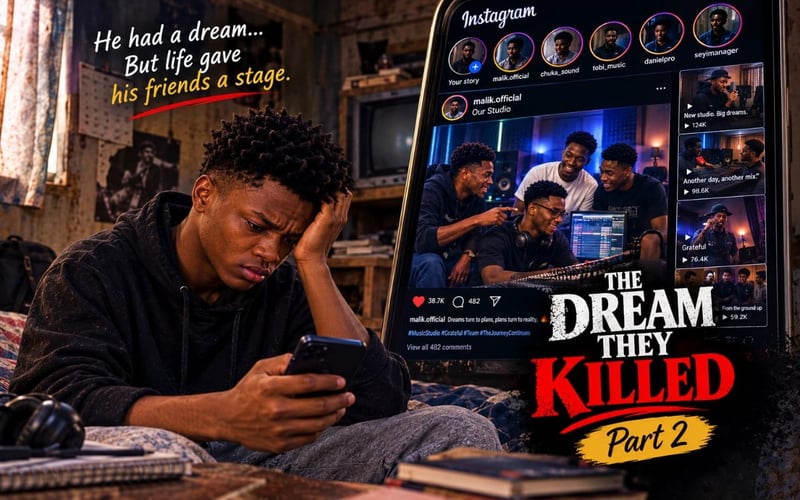
PART 2: THE PRICE OF A LOST DREAM
“We have discussed this matter, and your mother and I have reached a decision.”
Tunde stood before him.
“What decision, Daddy?”
His father looked at him.
“You are changing schools.”
Tunde stared at his father.
“What?”
“You heard me.”
“But why?”
“We believe it is best for you to be in an environment where you can concentrate on your studies and focus on the things that matter.”
Tunde looked at his mother.
“Mummy?”
She avoided his eyes briefly before answering.
“Your friends are becoming a distraction. We cannot continue watching you follow people whose interests are leading you away from God.”
“But they are my friends!”
“You will make new friends.”
“I don't want new friends. I want to stay with the people I know.”
His voice began to break.
His father stood up.
“This is not a discussion, Tunde. We are your parents. We know what is best for you.”
Within weeks, the arrangements were completed and Tunde was transferred to another school.
He lost the opportunity to attend the training with his friends. He lost the daily conversations, the jokes, the little arguments about music and the excitement of planning something together.
He also lost the comfort of being around people who understood an important part of him.
At first, he tried to maintain contact.
He sent messages to Daniel and the others, asking how the training was going.
They replied with pictures and updates.
Malik sent him a photograph of their first practical session. Chuka sent a short video showing them learning how to arrange different sounds.
Tobi complained that the lessons were difficult but added that he was enjoying every moment.
Daniel sent him a voice note.
“Guy, you should have been here. Today, they showed us how to work with different sound layers. I remembered you immediately because you would have had plenty to say.”
Tunde listened to the message several times.
He had imagined himself standing beside them, asking questions, making suggestions and learning how to turn the sounds in his head into something real.
Instead, he was sitting in a different school, trying to convince himself that everything would eventually be fine.
As the weeks passed, the messages became less frequent.
His friends were busy with their training and schoolwork. They were learning new things, practising and gradually becoming better.
Tunde did not blame them.
He knew they had their own lives.
But he missed them.
The training programme eventually ended, but the boys did not stop.
They continued practising, sharing knowledge, correcting one another's mistakes and looking for opportunities to improve.
Daniel's parents continued supporting him, and his pastor remained encouraging.
The boys were not successful overnight. There were difficult days, failed attempts, rejected applications and moments when they questioned whether they were making the right decisions.
But they kept going.
Tunde, on the other hand, gradually stopped talking about music.
At first, it was because his parents did not want to hear about it.
Later, it was because he had become tired of explaining himself.
Whenever he heard a song he liked, he still found himself paying attention to the arrangement. Whenever he watched a music production video, he would pause and study what was happening.
But he no longer had anyone to discuss those things with.
He tried to focus on school.
He grew older, completed his education and began looking for ways to support himself.
His parents had always hoped that he would secure a stable job, become financially comfortable and live a respectable life.
Tunde wanted those things too.
He wanted to make his parents proud. He wanted to be financially independent and stop worrying about money.
But life did not turn out as easily as he had imagined.
Several years passed, and he found himself struggling to establish a career.
He applied for jobs, attended interviews and accepted opportunities that paid very little. Sometimes, he worked for months without receiving what he was owed.
There were days when he calculated his transport fare before deciding whether he could afford to attend an interview.
There were evenings when he returned home exhausted, wondering how much longer he would have to keep struggling.
His dreams had become smaller.
Not because he had stopped wanting more from life, but because survival had gradually taken priority over everything else.
He had bills to pay. He had responsibilities. He had to think about what he would eat the next day.
The boy who once imagined creating music for a living had become a young man trying to find enough money to get through the month.
And although he rarely spoke about it, he never completely forgot what had happened.
One evening, after another disappointing day, Tunde sat on the edge of his bed scrolling through social media.
A familiar face appeared on his screen.
It was Malik.
At first, he almost scrolled past.
Then he noticed the caption.
Malik had just announced the opening of his own music studio.
The photographs showed a beautifully arranged recording space, professional equipment, soundproofed walls and a large mixing console.
Tunde stopped scrolling.
He opened the post.
There were hundreds of comments congratulating Malik. Some came from established musicians, producers and entertainment personalities.
He clicked on Malik's profile and began looking through his pictures.
He looked successful.
Not just someone who had managed to turn a hobby into a small business, but someone who had built an actual career from the opportunity they had once discovered together.
Tunde smiled.
“Wow, Malik.”
He was genuinely happy for him.
Then another familiar face appeared in the suggested posts.
It was Chuka.
Chuka had become a sound engineer and was now working with several recording artists.
Tunde kept scrolling.
Tobi had become a recording artist.
Seyi was working as a music manager and had built connections within the industry.
And Daniel?
Daniel had become a music producer too.
His parents had continued supporting him, and the boy whose pastor once prayed for his musical journey had grown into a man who was making a living from the very skill Tunde had been forbidden to learn.
Tunde opened Daniel's profile.
He saw a photograph of Daniel standing in a studio with his parents.
The caption spoke about gratitude, hard work and the people who had believed in him from the beginning.
Tunde stared at the picture for a long time.
He remembered Daniel's excitement when they first discovered the training programme.
He remembered how Daniel had told him that his parents were supporting him.
He remembered the pastor placing a hand on Daniel's head and praying for him.
He remembered his own parents dismissing the pastor as a take-away pastor.
A bitter smile crossed his face.
The same opportunity.
The same interest.
The same faith.
But two completely different outcomes.
He wondered how many other young people had experienced something similar.
How many children had been discouraged from pursuing legitimate careers because someone had labelled their interests worldly?
How many talented young people had been made to feel guilty for wanting to become actors, musicians, fashion designers, dancers, writers, filmmakers or entrepreneurs?
How many had watched their opportunities disappear while adults convinced themselves they were protecting their souls?
He knew there were dangers in every industry. He knew that talent without discipline could lead nowhere. He knew that success could expose a person to temptations and choices that required wisdom.
But those were reasons to guide a young person, not destroy every opportunity before they could even begin.
A child who wanted to become a musician could be taught discipline.
A child who wanted to become an actor could be taught boundaries.
A child who wanted to become a fashion designer could be taught integrity.
A child who wanted to explore a talent could be guided without being condemned.
Faith should not make parents blind to their children's abilities and the church should not make young people believe that God's purpose for their lives begins and ends within its four walls.
Tunde picked up his phone again.
He returned to Malik's photograph and stared at the studio.
For a moment, he imagined himself standing in a place like that, surrounded by equipment, listening to sounds and creating something from nothing.
He imagined Daniel calling him to work on a project.
He imagined the excitement of completing his first major production.
He imagined a different version of his life.
Then the picture disappeared as his screen went dark.
He placed the phone beside him.
There was no way to return to that afternoon when he had stood in the sitting room, begging his parents to let him attend the training.
There was no way to recover the years he had lost.
He could not go back to his old school, gather his friends and begin again as the sixteen-year-old boy who had once been so full of hope.
All he had were memories.
And the painful knowledge that the opportunity had been real.
It had been free.
It had been available.
His friends had taken it.
Daniel had taken it.
They had all started from somewhere, and through practice, patience and consistency, they had built lives around something they loved.
Tunde had not been given the chance to start.
He was not saying that he would certainly have become as successful as they were. Nobody could know that.
But he could have tried.
He could have failed, learned, improved and tried again.
He could have discovered whether music was truly his calling or simply a passion he enjoyed.
I
nstead, the decision had been made for him before he had the opportunity to discover what he was capable of.
His parents had believed they were protecting him.
His mother had believed she was defending the faith.
His father had believed he was exercising parental authority.
And the church environment they trusted had given their fears the appearance of spiritual certainty.
But years later, Tunde was the one living with the consequences.
He looked at his phone once more and saw Daniel's last message.
“Don't lose touch this time, bro. We should catch up one day.”
Tunde smiled faintly.
“I'd like that,” he replied.
Then he put the phone down.
He was happy that his friends had made it. He genuinely was.
But he could not help wondering how different things might have been if someone had believed in him too.
Sometimes, a dream does not die because a child lacks talent, discipline or opportunity.
Sometimes, the opportunity is right there. The talent is present. The child is willing to learn.
But the people entrusted with guiding that child become the very people who stand in the way.
And sometimes, a church that should help people discover and develop their God-given abilities becomes so consumed with a narrow definition of spirituality that it fails to recognise God's work beyond its own activities.
It teaches people to pray for success but questions the professions through which that success might come.
It encourages talents on the altar but condemns them in the marketplace.
It speaks about taking over the world but discourages young people from developing the skills that could help them contribute to it.
And the saddest part is that those who create these limitations may never realise what they have taken away.
They may even spend the rest of their lives believing they did the right thing.
Tunde had not lost the opportunity because God had rejected his talent.
He had lost it because the people who were supposed to guide him had been taught to see God's work as something much smaller than it was.